An Iberian solution for Europe – Article on Cinco Días (El País)
Natalia Fabra contributed an opinion piece in Cinco Días (El País) discussing how Europe can better address future energy crises and the lessons from the Iberian electricity market.
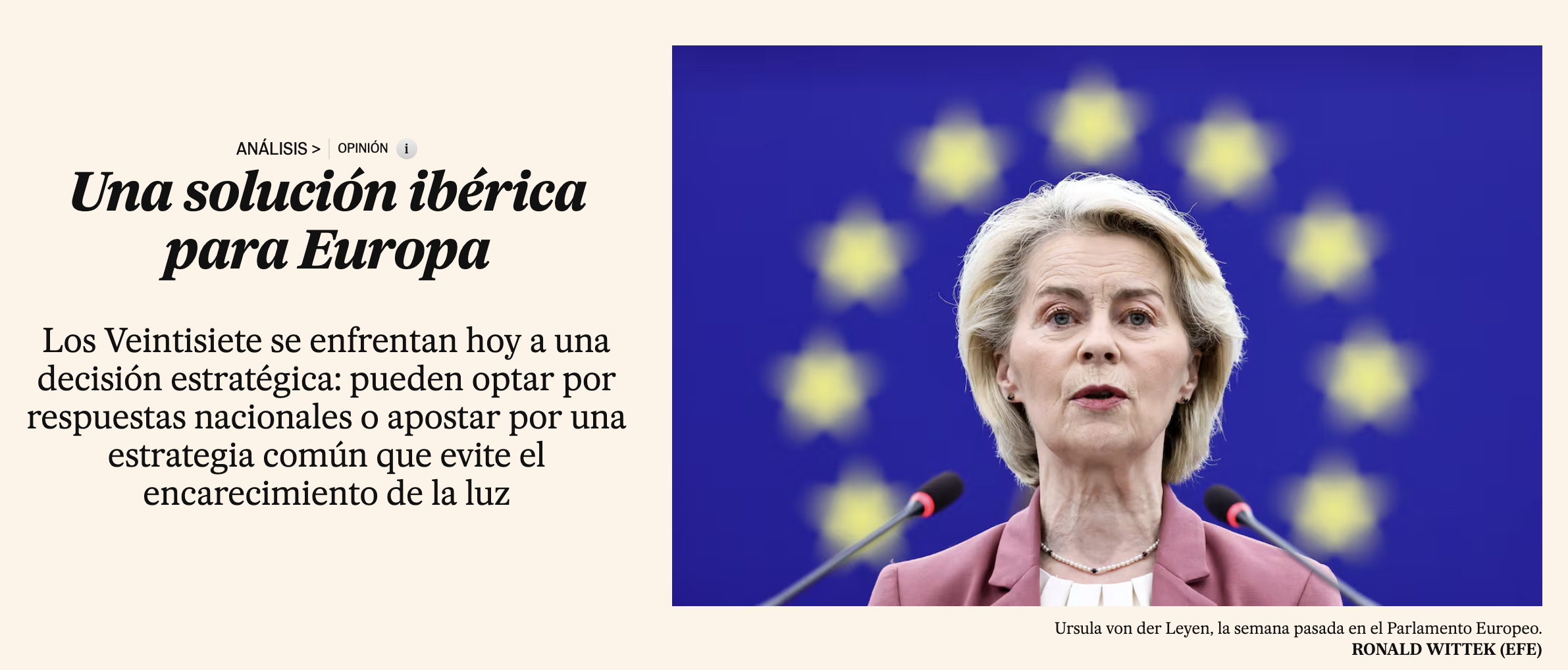
In the article, “Una solución ibérica para Europa,” she highlights how the Iberian mechanism helped contain electricity prices and inflation in Spain and Portugal during the recent energy crisis.
An English translation of the article is available below.
The original Spanish version can be consulted here.
Europe is well aware of the damage caused by energy crises. Looking back just five years is enough to recall what happens when a reduction in gas supply drives up prices, and these increases are immediately transmitted to electricity markets, where gas-fired plants still play a key role in price setting. Rising energy costs fuel inflation—including core inflation—and ultimately make tighter monetary policy unavoidable.
We do not want history to repeat itself, including in the energy sector. Structural solutions must start from a clear diagnosis. The rise in energy prices is rooted, on the one hand, in our dependence on fossil fuels and, on the other, in an electricity market design that remains overly reliant on short-term markets, which transmit the costs of the most expensive technology to all generation technologies.
Structural solutions should therefore focus on accelerating investment in renewables, storage, grids, and electrification—all essential to removing fossil fuels from our energy mix. They should also include a stronger reliance on long-term energy contracts, which help reduce the cost of deploying renewables and prevent electricity prices from being driven by fossil fuel volatility and geopolitical shocks. Decarbonization is not only a climate objective: it is also about competitiveness and strategic autonomy.
But what can be done in the meantime to avoid another price spiral? Spain and Portugal provided an answer during the recent energy crisis. In times of emergency, the best policies are not necessarily the most refined ones, but the most effective. The Iberian mechanism was effective because it targeted the problem at its source: it effectively reduced the excess revenues of technologies such as nuclear, hydro, and renewables that sell into the market—technologies that do not rely on fossil fuels, yet benefit from electricity prices inflated by higher gas and CO₂ costs. Moreover, by lowering electricity prices, the mechanism not only helped contain inflation in Spain but also had positive distributional effects, providing relatively greater relief to lower-income households. By contrast, relying solely on public spending or tax cuts shifts the burden to taxpayers without addressing the underlying problem.
The Iberian mechanism also had a side effect: by lowering electricity prices in Spain, it increased exports to France, raising gas-based generation domestically and benefiting French consumers, who accessed electricity partially subsidized by Spanish consumers.
Extending an Iberian-style solution across Europe would prevent cross-country subsidies, reduce inflationary pressures and the risk of higher interest rates, help protect the competitiveness of European industry at a critical time, and ease the pressure to weaken climate policies as a way to lower energy costs.
Europe now faces a strategic choice. It can rely on national responses that temporarily ease energy costs but fragment the market and distort electricity trade. Or it can adopt a common solution that, without requiring public spending, prevents electricity prices from being driven by excessive dependence on fossil fuels and by a market design that amplifies their negative effects on firms and households.
As long as the war continues, and as Europe advances toward decarbonization—a goal that will be difficult to achieve without reforming electricity market regulation—we should support an Iberian solution for all of Europe.